Is the ‘face’ of your business sending the right message?
The other day, I dropped in to a local cupcake shop on the way to a concept development meeting (because eating cupcakes while getting creative is pretty nice really). One of my dragonflies was with me, and we approached the counter and greeted the sales girl.
Blank stare. ‘Yes?’ was her response to our friendly greeting.
We did a double-take but proceeded to choose our cupcakes – which took all of 30 seconds. Okay, maybe 40. There were a lot of great choices. She stood there with her eyes rolled to the ceiling… Clearly, in this empty shop, we were taking up her valuable time.
When we made our choices, she put them in the box, dumped it on the counter, snapped out the amount, and took my money. She handed back the change, again without a word, and we both stood there gobsmacked. I wanted to say, ‘I’ll have my money back, thanks. I don’t want these cupcakes anymore’. But I didn’t.
Instead, we both walked out of that cupcake shop with a bad taste in our mouths. I wonder if the business owner realises how much custom the ‘face of his business’ is turning away? I’m sure you’ve got your own stories of people who act like they’re doing you a favour, when they’re being paid to serve you.
There are great stories too. Like the medical receptionist at a specialist I go to who’s friendly and helpful – all the time. She might be having a bad day, have a full waiting room and a hundred letters to type, but that doesn’t affect how she deals with each customer. Guess what? I always recommend that specialist (who’s also very professional and always pleasant) to my friends and family.
And that brings me to branding. Businesses will pay a lot of money to build brand recognition, while the human ‘face’ of their business may be undoing all that good work.
Why? Because customers talk, and word of mouth is the best, most cost-effective, and most powerful marketing tool you have at your disposal.
What does the face of your business look like? Is it sending the messages you want it to? Are your people’s attitudes consistent with the way you promote your business? Do customers get the experience they expect from you – every time?
Customer service expectations need to be clearly communicated to your people – particularly those dealing directly with your customers. It’s not enough to expect your employees to know how to act, or to know that the way they behave is an important factor in your business’s success (and therefore their jobs…).
It’s vital to regularly evaluate performance too, and to recognise and reward good performance.
Think about cupcakes. No matter how great those cupcakes are, we won’t be going there again. Which is good for our waistline – but not good for their bottom line.
Is it time to look at the face of your business?
Shorter working hours: good for us, good for business
Think about your average day at work. How productive are you…really? How much fully-focused project work do you get done daily? How much overtime do you clock up in a week, a month, a year?
According to an article in the Courier Mail last weekend (Price to pay for overwork, Careers, p5), Australians clock up some of the longest working hours in the developed world. And it’s affecting our stress levels and our productivity!
If you’ve ever had the joy of working undisturbed for any length of time, you’ll know that 5-6 hours productive working time is as good as it gets. Sure, we can put in 10 hour days, but are we really producing our best work or great outcomes? Apparently not – and we’re not doing ourselves (or our bosses) any favours either.
Should Australians adopt shorter working hours? Would we get more done? Would we be more productive? I’m sure we would. After all, we’d have more time to spend with friends and family, more time to exercise, and more time to chill out and regroup. Surely we’d come back the next day more refreshed – and ready to get stuck into our jobs again?
It may also improve our mindpower…
Sounds to me like shorter working hours are good for us… and good for business.
cheers
Louise
More jazz… outsourcing design
You’ve found a great copywriter and it’s time to call in a graphic designer - but you feel like you’re about to land in a foreign country (without a map). In our last blog we talked about outsourcing writing and editing. Now here’s some useful design-land travel tips…
‘We need some marketing material. Maybe a brochure?’ you squeak out in your best approximation of graphic design speak. But then come all the questions full of words you just don’t comprehend…
DL? A3 folded to D5? Gateflaps? Will it be available online? And images…JPEG? GIF? PNG? (Isn’t that one of our Pacific neighbours?) There are different images for a website? Four-colour or spot? Do you want it to bleed off? Got a bromide? What about bmps, eps and wmfs? STOP!
It’s time to read our (Hitch Hiker’s) guide to graphic design, and most of all – don’t panic.
First of all, remember that your role is to communicate what you want from the final product, not provide the technical know-how to get there.
Knowing the language designers speak can be helpful, but the right graphic designer will provide a better design than you ever imagined. They’ll also let you know exactly what they need from you.
“What we want them to come to us with is an open mind,” says Adrienne Williams, graphic designer and owner of See Saw Illustration and Design. “They can come with a degree of detail about what they want, but during that first meeting they might discover the product they wanted might not be the right one.”
So before you meet with your graphic designer, think about designs you’ve seen and liked. Collect samples. Are there any colours you prefer? Do you want the colours to be warm, bold or neutral? Are there corporate identity requirements for colour, logo, or wording? Simple but effective descriptions can help a graphic designer choose, or create, the right colour and ultimately the right look for you.
Adrienne also suggests clients bring examples of what they don’t like, especially with logos. “It really gives us an idea of where their tastes lie and how they want to be portrayed.”
Entering design-land can have plenty of oo-ah moments. We hope this helps you enjoy the trip.
cheers
Lou & Sandra
Dragonfly team
All that jazz…outsourcing writing jobs with confidence
Some time ago, I was asked to jazz up an existing short profile for a client’s upcoming television appearance.
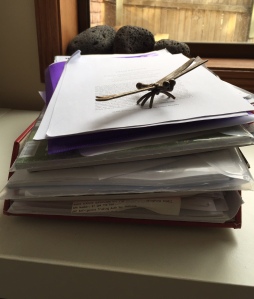
Imagine my surprise when a pile of clippings, notes and pages as thick as a best seller arrived in the post. What my client wanted wasn’t editing, it was content creation.
Yes, I delivered the va-voom, but it highlights how important it is that we are all, um, reading from the same page (did I really say that?). So what’s the difference?
Proofreading is really a quality control exercise. We make sure all amendments have been included, the document is complete (lines or words haven’t ‘dropped off’ the page, etc), links work, there are no spelling or punctuation errors, the document conforms with the client’s style guide, the index is correct, and page, line and word breaks are suitable.
Copy editing focuses on style and consistency. We make sure the meaning is clear and correct grammar, punctuation and spelling are used. We check for consistency, such as capitalisation and numbering.
For online work, we check links, pop-ups, and metadata, and make sure files download or open properly, with ‘user-friendly’ speed.
Full editing, referred to as substantative editing, involves all of the above, with the added task of reviewing structure, language, style and clarity or usability. A full edit focuses on making a document easy to read and consistent.
Content creation is a term our Dragonfly team uses to describe developing content from information we’ve gathered or our client has supplied.
Content creation can involve all or a mixture of writing styles including storytelling (narrative), information or explanation (expository), and influencing behaviour or opinion (persuasive).
Content creation involves, in varying degrees, the following process:
- Briefing, including establishing audience, message, and method of delivery
- Gathering and reviewing information, often including conducting interviews
- Brainstorming ideas and developing concepts or themes
- Developing text through various draft/approval phases
- Delivering final edited content, often including design suggestions
So next time you’re thinking about outsourcing your writing or editing work, you can relax because you’ll know what you’re asking for – and what to expect. I could say something here about us all singing from the same… but, no. I think it’s home-time.
cheers
the dragonfly
Women at work. Now, and then…
Here’s an insight into just how tough that glass ceiling used to be for us girls. It’s a Minute Paper from 1963 about whether or not to have women as trade commissioners in Australia.
I’m particularly fond of reason (viii): “A spinster lady can, and very often does, turn into something of a battleaxe with the passing years. A man usually mellows.”
There’s not a lot of beating around the bush there.
It’s good to know how very far we have come. But perhaps not far or fast enough…
Improve your mind power…leave work on time!
You’ve probably had days where you forget stuff, times when your brain seems to turn to sludge and you can’t remember your own name, let alone anyone else’s. Imagine every day being like that.
We take our mind power for granted, especially when we’re working and apparently exercising it. Crosswords and brain exercises are for oldies, right?
Think again. Trying to impress your boss or co-workers by starting early and finishing late just might backfire on you.
If you’re working more than 55 hours a week, your cognitive function – memory, attention, and reasoning – may be affected.
In January 2009, the American Journal of Epidemiology published the*Whitehall II Long Working Hours and Cognitive Function study. It found that middle-aged people working 55 hours a week didn’t perform as well as those working 40 hours a week.
In fact, when it comes to memory, attention and reasoning, the decline from overworking is on a similar scale to smoking, a known risk factor in dementia.
Even if you haven’t hit middle-age, you’ll be forming work habits that you’ll find hard to break later.
So whatever stage of life you’re at, aim for balance (and I’m not talking bank balance). Your mind-power may depend on it.
*Stephen Pincock talks about this and other intelligence research in his book Get Smart! 100 Lifestyle Choices That Affect Your Brain (published by Hardie Grant Books).
Demystifying SEO-speak
The language of Search Engine Optimization (SEO) is enough to make your head spin. But it’s not rocket science. Here are some quick definitions to get you started:
- SEO: the process of improving your website/blog ranking in search engine results
- Keyword density – No, it’s not repeating yourself, repeating yourself, ad nauseum. It’s the number of times your keywords appear on your page (without sounding ridiculous!)
- Title text – Look at the very top blue line of your browser page. It should be different for every page, used like a magazine article title, and include keywords…
- Meta-description – This appears in search results. It’s those approx 160 characters that can make people click through to your site – or not
- Header text – This is HTML coding that indicates the relative importance of that block of text, like main heading and sub headings. Tip: Use keywords in header text (as long as it doesn’t sound stupid)
- Link titles – This is the text that appears when you scroll over a link. Check your site. Are you linking from ‘click here’ or ‘more’? Make that text meaningful
- Image titles – Ditto. Make these meaningful. ‘Spiders’ love pictures and video, so don’t waste your opportunity to get ‘picked up’
- On-page factors – These are the things mentioned above, the things you can do on your own site
- Off-page factors – Google and other search engines like quality inbound links from other sites to yours.
No more spinning heads? Excellent!
cheers
Lou (aka The Dragonfly)
Increase your productivity – at work and in life
Dean Jackson’s 50-minute focus finder is priceless. Have you got 50-minutes to watch his presentation?
With a healthy level of skepticism, I sat down to do Dean’s focus finder exercise (one of several he talks about). It’s really a brain dump, which you do for 50 minutes – listing every single thing that comes into your head.
After about 10 minutes, you move from the reactive zone (phonecalls, meetings, people to see, things to fix, emails to respond to) to the proactive zone (new ideas and approaches, new markets to explore, etc).
To my surprise, it worked. And I’ve already put some changes in place… others are on the list. So I’m a convert. It’s a pretty worthwhile way to spend 50 minutes…
KISS and tell…
Okay, I’m finally admitting it. I’m a stripper by trade. I make no apologies and I’m not about to give it up.
But wait…before you run screaming from the room, let me explain. I take a big, overdressed concept and start to strip it back bit by bit. I play with it, readjust it and take a bit more off.
Finally, I strip out the adverbs, fling off the adjectives – and now I’ve got something my audience will pay attention to.
If you want to be read, you’re going to have to do a bit of stripping yourself. Most people won’t bother wading through convoluted prose to get your point, so here are some ways to make your writing sizzle:
Short is sweet: Use short sentences with one thought to a sentence. Cut long, rambling sentences into two or three short, punchy sentences.
Looking good: Keep paragraphs short to avoid big slabs of text on the page, especially if your work will appear in columns.
Stay active: Lose the passive voice. Look for ‘by’ in your sentences and rework them, and have people doing things, rather than things being done by people.
Liven it up: Turn nouns into verbs, e.g. ‘provision of’ (noun) can become ‘will provide’ (verb), and ‘give consideration to’ becomes ‘consider’.
Keep it simple: Use fewer words to get your message across, e.g. ‘close proximity’ becomes ‘near’, ‘are in agreement’ becomes ‘agree’, ‘despite the fact that’ becomes ‘although’.
What the…? Avoid tautology or stating the obvious – new innovation, future potential, mutual cooperation. And clichés – cutting edge, world beating, revolutionary.
At school, we all knew how to impress the teachers…use big words and expand one or two ideas into 800 words. In the business world, we lose marks for being complicated and long winded.
The key is to Keep It Simple for Success.
Now, where’s that feather boa…?
Can you feel the love?
Don’t you love those opinion polls that come up with definitive stats about what women/ men/ kids/ bosses/ employees/ mothers/ fathers/ retirees/you-name-them want? Nobody has ever asked me. Or, I confess, if they’ve called on a Sunday or after six I’ve fobbed them off (Nicely of course).
In business, it’s easy to fall into the trap of ‘knowing’ your clients – but do you really know them? When was the last time (or the first time?) you asked them what they need or want? Do you understand why they buy from you, or don’t? Do you understand the space they’re in right now?
And if they’re telling you, are you really listening?
Take a quick look at The Break Up*? It’s a nice exploration of the relationship between you and your clients / customers – or, rather, a nice reminder of the relationship you don’t want to foster…
Can you feel the love?
cheers
Louise
*Creds to colleague and business coach Lisa Murray who mentions this on her website.
Leave a Comment
Leave a Comment
Leave a Comment